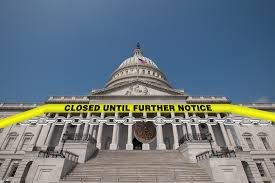

Amid the series of policy changes under the Trump administration, news of the government shutdown surfaced for the second time. Following an impasse on Capitol Hill over the congressional spending bills, the federal government shutdown took effect on Oct. 1.
Consequently, this shutdown has impacted the occupations of government workers and officials. As the shutdown approaches the second-longest duration, the Trump administration is leveraging priorities it supports while working rapidly to dismantle those it does not. According to the Congressional Budget Office, 750,000 civilian employees are projected to be fired each day, with the largest cuts in the departments of Treasury, Transportation, Health and Human Services, Education, and Housing and Urban Development.
In my search for personal accounts of the government shutdown, I spoke to a Parsons School of Design student, Sejung Kim. After her trip to Fort Lee, she said, “I saw the Fort Lee fire department busking and asking for money on roads; specifically, now through digital and car systems, it is hard to witness these workers who work to protect us, while most people like myself don’t carry around cash anymore.”
On Oct. 3, ABC News’ Mary Bruce asked White House press secretary Karoline Leavitt about Trump’s deepfake videos with the intention of threatening mass firings. Leavitt claimed that this online trolling is the White House’s attempt to avoid cuts.
“The president has described this as an unprecedented opportunity to lay off additional workers. He’s posted a video likening it to the Grim Reaper. Which is it? Is this an opportunity to fire more workers or an unfortunate consequence?” Bruce asked.
Air Travel
As concerns about the impacts on travel grow, questions such as “Will TSA work?” and “Will my flight be canceled?” continue to arise. These are entirely valid questions in a situation where air traffic controllers and the TSA are expected to work without compensation. Even though commercial flights won’t be canceled, during the 2018 shutdown, the TSA spokesperson reported that an increased rate of workers called off work due to financial struggles, resulting in slow lines, flight delays, and cancellations. Thus, if this shutdown prolongs more than 35 days, the past may repeat itself.
National Zoo and Park Closures
According to the Bipartisan Policy Center, about 1.4 million federal workers continue to work unpaid, while Congress still has yet to reach a deal to reopen the government. The 19 Smithsonian museums and the National Zoo managed to remain open with their previous budget funds. Still, as the government shutdown quickly reached three weeks, the zoo said in a post on X, “Due to the government shutdown, Smithsonian museums are temporarily closed beginning on Sunday, Oct. 12, along with our research centers and the National Zoo.”
As many of the zoo’s visitors would be concerned about animal well-being, the zoo assured on its website that animals “will continue to be fed and cared for.” Even though the website states that the zoo’s live animal camera will not run, many tourists were left disappointed when they arrived at the National Museum of Natural History and the Smithsonian Museum exhibits to find they were closed with no further notice.
While many national parks have only limited their services, the Capitol and Pentagon tours have been canceled.
Toll on the Arts
While the Trump administration deems services such as border security and law enforcement essential for the duration of the shutdown, other government activity, including the country’s most visited museums and national historical sites, is frozen. These art institutions depend on federal funding.
According to The New York Times, the National Gallery of Art closed on Oct. 4. The largest portion of the NGA’s funding is allocated from the federal government. According to The Art Newspaper’s latest survey of museum visits internationally, the National Gallery of Art is the seventh most frequented art institution, with almost 4 million visitors a year.
Although New York outdoor sites continue to run, they are running without staff, tours, or public restrooms. As a result, this means that with no staff, the National Park Service claims that collecting trash and overseeing maintenance could be suspended.
However, art institutions that receive private funding will keep their doors open during the shutdown. In Washington, the Phillips Collection and the nearby Baltimore Museum of Art will stay open, and in New York, the Metropolitan Museum of Art and MoMA will as well.
As this shutdown presents real-world economic and social challenges, Moravian University students in economic and/or political classes can critically analyze what are and what aren’t “essential government services.”