

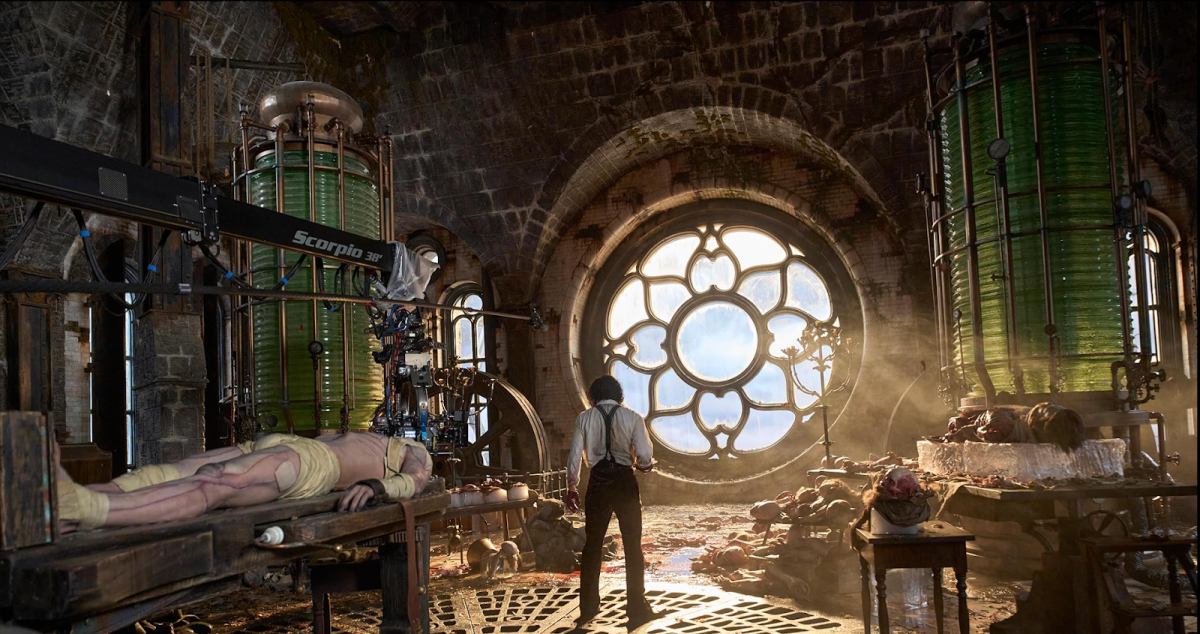
If you haven’t seen any of Guillermo Del Toro’s films already, you’re doing yourself a massive disservice. The man is known for his ability to mesh the macabre with the beautiful in almost every work he produces, and this movie was no exception.
After releasing at Venice’s International Film Festival in the summer and a limited theatrical run in October, “Frankenstein” finally shambled its way onto Netflix on Nov. 7. I think I can safely say that this film was definitely worth the wait.
Del Toro’s adaptation of Mary Shelley’s iconic novel opens on an icy wasteland, where a gravely injured Victor Frankenstein, played by the versatile Oscar Isaac (“Moon Knight,” “Across the Spider-Verse”), recounts the harrowing tale of his twisted machinations’ conception. As he and the crew of a Danish ship attempt to survive the frigid climate, they’re relentlessly hunted by the Creature, played by “Euphoria”’s Jacob Elordi.
This film was stunning. From the opening frames, the mood is immediately set at a dismal low, beginning with the atmosphere of the North Pole, drenched in cold blue and shadowy light, before shifting to a Gothic Victorian England. The details were strengthened by work from cinematographer Dan Laustsen, who previously collaborated with del Toro on “The Shape of Water” and “Crimson Peak.” It’s truly a work of art, the visuals drawing me into every little detail, especially helped by the abundance of practical designs for costumes and the monster himself.
Isaac’s performance was nothing short of brilliant, portraying the good doctor as a madman consumed by his own ambitions in a way that’s eerily relatable, rather than a raving lunatic trying to play god. He’s a complicated fellow, a father struggling to handle the child born of his actions (which immediately made me flash back to Toro’s take on “Pinocchio” three years ago).
I’ll admit, I wasn’t the biggest fan of Elordi after a string of crummy romcoms on Netflix, and Andrew Garfield being the actor he replaced had me hesitant to watch, but he won me over as Frankenstein’s Monster. He brought a surprising degree of emotional vulnerability to the character, illustrating the Creature’s humanity. The other cast members are standouts as well; the friend I watched the film with had a field day gushing over Mia Goth as Elizabeth Harlander, the Creature’s only true companion. She delivered such a warm performance to the gloom hanging over the narrative.
While the two-and-a-half-hour runtime might be a deterrent to some, “Frankenstein” is a film that sets itself apart from other adaptations by breathing new life into Shelley’s original vision. It’s safe to say that with good direction, flashy visuals, and powerful performances, this story of “Frankenstein” still has a pulse after all this time.


