

I owe you an apology, James Cameron; I wasn’t really familiar with your game.
I’ll be so honest, the “Avatar” franchise never really fascinated me. When I first watched the film on FX several years ago, I didn’t really care for the fact that it was three whole hours. It was too much for my seven-year-old attention span. My love for the namesake lay solely with “Avatar: The Last Airbender,” and I was more annoyed than anything by having to clarify which IP I meant whenever I brought it up.Then Winter Break came. My best friend, Alondra, called me, asking if I wanted to indulge in a makeshift movie marathon — which just so happened to coincide with the release of the latest entry in the franchise: “Avatar: Fire and Ash.” One weekend’s worth of binging later, and I can safely say the films definitely lived up to the hype.
“Avatar” follows the Resources Development Administration, or RDA’s, expansion onto Pandora, a lush alien world whose resources are coveted at the expense of its native population, the Na’vi. Jake Sully, a paraplegic soldier, has his mind transferred into an eponymous “Avatar,” a homunculus (artificial body) from Na’vi DNA, to infiltrate the culture. However, Jake’s mission is compromised when he meets Neytiri, a Na’vi woman he falls for, leaving him torn between the world he’s known and an entirely new one. In “Fire and Ash,” Sully and his family are faced with the machinations of the Mangkwan, a tribe of ruthless, warmongering Na’vi who ally themselves with the RDA to exact revenge upon our intrepid heroes.
This is one of the most expensive films ever made, and it shows. The first “Avatar” was groundbreaking for the development and use of visual effects in its production, and the work here was an absolute visual spectacle, as always. Pandora feels more developed than ever, with volcanic landscapes, heightened drama, and a sense of scale that very few filmmakers can deliver. The music matches the imagery beautifully, swelling and surging to punctuate dramatic fight scenes and emotional gut-punches over the course of the film.
The movie deals with grief and hatred like no other. Neytiri’s misanthropy reaches a breaking point as she deals with her own loss. The characters have beautiful arcs that feel natural, rather than forced for tension. I’ve heard people criticize it for being a retread of the second film, but I think it ties up most of the threads left open and answers so many of the questions from its predecessor, “The Way of Water.”
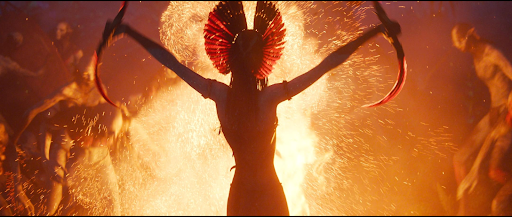
The cast remains a delight as well, with a personal standout being Oona Chaplin (who was also an actor in “Game of Thrones”) as the leader of the Mangkwan, Varang. She’s not just another standard villain— she has her own identity, theme, and style, reflected in her personality, design, and even the score. Her leitmotif, “Hero of Her People,” blends ominous choir singing with maritime strings. Composer Simon Franglen did a great job! She feels perfectly suited for this story, volatile as the fire she commands, and I’m hoping she becomes a genuinely memorable villain.
In short, “Avatar: Fire and Ash” is a massive expansion of the universe that proves this franchise still has plenty of heat left.


