

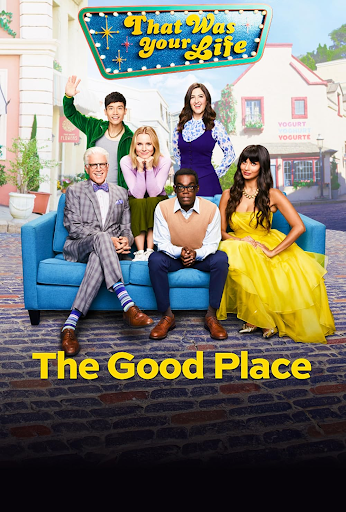
The first time I watched “The Good Place,” I went in completely blind; I had no idea what the show was about, and someone had put it on for me with no explanation.
For the first few minutes of the first episode, I was horrified that the person who showed me this show was a fire-and-brimstone Mormon, especially as someone who did not have a great experience with organized religion growing up.
But “The Good Place” stands out as entirely different from every single sitcom I have ever watched; this show taught me so much about myself and the world, and I’ve already rewatched it twice since my first viewing only a year and a half ago.
If I have any advice for you, if you have not watched the show yet, go watch it without any outside interference or spoilers. Look away from this article, RIGHT. NOW. “The Good Place” is best ingested when you watch it without any prior context — it is the type of show that you really should enter without knowing anything prior.
Without spoilers, the main character, Eleanor Shellstrop (Kristen Bell), wakes up in the afterlife and is told she lived such a good life that she earned a spot in “The Good Place.” The problem is: she knows she absolutely did not; she lived a sinful life, and knows she is harboring a deep secret from the rest of the “deserving” people in “The Good Place.” She seeks out Chidi Anagonye (William Jackson Harper), a philosophy professor in his past life, for advice on becoming a better person, thinking that if she can pretend to be a good person, she eventually will become one.
Now, if you don’t care or if you have already watched the show, here’s what I think.
The cast is one of the funniest and most charismatic groups I’ve seen on screen: There’s a character or flaw that every single viewer can relate to, and the show slowly builds your empathy towards the characters without you even realizing it.
Ted Danson (Michael) does such a convincing performance, and he deserves every single award he was nominated for and then some.
Jason Mendoza (Manny Jacinto) is so hilarious, and his storyline is just insane and lovable. Imagine the biggest fratboy you know mistakenly making it to Heaven on someone else’s name, who was apparently a monk, and now he has to abide by a code of silence. If you think that’s funny to imagine, it’s even funnier to watch it play out.
Janet (D’Arcy Beth Carden) plays such a convincing Heaven robot, and although she’s not one of the core four cast, she is one of my favorites. Eleanor reminds me so much of myself in the best and worst ways, and she is the best protagonist I could imagine to hold down the rest of the cast.
Tahani Al-Jamil (Jameela Jamil) plays a socialite obsessed with status and reputation, and her constant name-dropping and insecurity make her both hilarious and surprisingly sympathetic.
I’ll admit I’m not the most perceptive person when watching media, but every plot twist in the show was a genuine shock to me (like, I would look at the person I was watching it with, making an “o” with my mouth).
I have never cried as much over a T.V. show until I saw this. The viewer develops an insane attachment to the characters, and the show only runs for four seasons, which is impressive in itself.
But what I love most about this show is how healing it was for me and my religious trauma, and I think anyone who watches this show will feel this way, especially as it has no actual reference to specific religious gods or writings like the Bible or Torah.
I genuinely feel like show creator Michael Schur is a genius, or had an insane near-death experience that triggered the inspiration for this show. I just can’t imagine how much creativity and optimism one must possess to write a television plot like this, so I tip my hat to him. And who can make philosophy funny? Apparently Schur.
The show also presents a strong philosophical angle, and I will admit I got excited every time I recognized a philosopher or theory Chidi mentioned in his philosophy classes.
Big spoiler alert here: one of my favorite theories that this show presents is that humans are inherently good, but are held back by the current state of the Earth: capitalism, racism, greed, and a single purchase might support child labor, pollution and exploitation.
It’s a relief when you’re watching to see yourself represented – in Eleanor’s selfishness, Chidi’s paralysis in making decisions, Jason’s chaos, Tahani’s vanity and jealousy – and it makes you realize, “Oh, so even though I’ve done bad things, I’m not a bad person?”
But through all of the life lessons, the show is fun and hilarious.
The idea of life after death and eternity is horrifying, but somehow, this sitcom makes it light-hearted and entertaining.
If death looks like anything, I hope it looks like “The Good Place.”


