

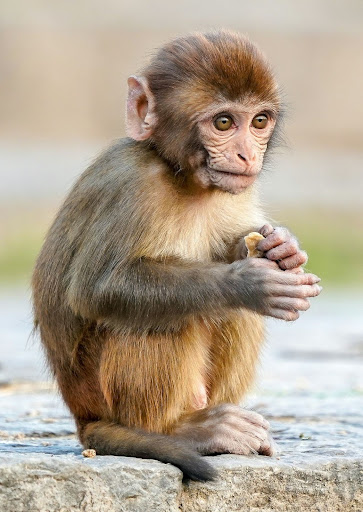
Scoot over, Moo Deng, there’s a new favorite baby animal in the house: Punch the Monkey. If you haven’t been following social media over the past few weeks, Punch the Monkey has stolen the hearts of millions of people across the globe.
Punch is a 7-month-old macaque monkey at Ichikawa City Zoo in Chiba Prefecture, Japan. After his mother abandoned him, zookeepers gave the little monkey a stuffed animal to hold and cuddle, and this has been driving the internet wild.
Everyone cares about this monkey, so there are almost daily updates on him, ranging from Punch being beaten up by other monkeys, accidentally falling into the pond while trying to grab a drink, to receiving his first hug from one of the other monkeys in the enclosure.
But this raises a larger question: why do humans love to anthropomorphize animals? And, once they grow up, why do we stop caring about them?
To anthropomorphize an animal is to ascribe human characteristics to it, even if the animal is not truly acting emotionally. I’ll admit that I am likely more guilty of this than most, especially as a writer – I’ve written multiple poems and creative non-fiction pieces from the perspective of animals, and I don’t know why I feel such a connection to them.
Issue number one: I don’t think it’s fair that we only care about the cute little animals in zoos and sanctuaries, and our attention span ends when they grow up or are in the wild. And, in the wild, this sort of abandonment and “bullying” is normal. It’s not fair to villainize animals for following their instincts.
And what about animals that humans do not find adorable? Species without big eyes or soft fur rarely go viral online, even though they are just as essential to their ecosystems. Others are valued not for their lives but for what can be taken from them: whale meat, shark fins and elephant tusks. If we truly care about animals, are we willing to sacrifice our wants in order to protect their needs?
According to the IUCN Red List, over 47,000 animal species are at risk of extinction, with poaching, habitat loss, and climate change as the main causes (yes, all human-caused). So, I don’t think humans are willing to surrender these desires to guard animals; we like to appreciate what animals have to offer without safeguarding them or their environment.
Baby animals are adorable, but how many people who swoon over creatures in captivity actually donate money to conservation efforts? However, there may be some ways that anthropomorphism can help conservation efforts.
A 2012 article, “Anthropomorphism as a conservation tool,” by the author Alvin A.Y.-H. Chan presents how animals should be better represented in media, such as animated films.
Instead of tragic depictions like “Bambi,” that contribute to the misrepresentation of hunting as unnecessarily violent when culling deer populations is actually important to ecosystem health, the author suggests relying on aspects of animals that are factually similar to humans, such as: “the intelligence of animals, their ability to experience pain, and their social behavior.”
Another author, Kim-Pong Tam, argues that, to care about the environment, humans must feel some sort of connection to it, so anthropomorphism could function as a low-cost approach to environmental conservation.
Punch the Monkey may be another fleeting internet sensation. In a few months, he will grow up, stop clinging to his stuffed toy, and likely disappear from social media feeds.
But the attention he receives now reveals something about human nature: we care most easily when we see ourselves reflected in other creatures. If anthropomorphism is what makes people pause, donate, or even think twice about the fate of a species, then perhaps that instinct is not entirely misguided – it’s time to just make sure we continue our care when these animals grow up.


