

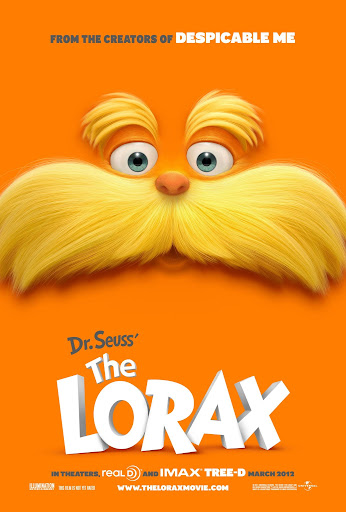
Dr. Suess’ “The Lorax” (2012) is a childhood environmentalist masterpiece, at least that’s what I thought in elementary school when it was screened every Earth Day. At a glance, it appears as another Dr. Seuss children’s movie, but as the Lorax’s purpose unfolds, the message of living without harming the environment is conveyed beautifully.
Thneedville’s Propaganda
The animated film kicks off with The Lorax introducing himself as the one “who speaks for the trees.” In this little introduction, he says,” But there’s more to this story than what’s on the page, so please pay attention.” The poetic speaker of the trees is our activist in this story; the one keeping viewers in check to prevent them from becoming like the Thneedville civilians. Thneedville is the main location in this story, a dystopian place with fake nature where air is monopolized because trees are nonexistent.
As the first song, “Thneedville” plays during a civilian musical number, it is evident that these people are conforming, thus becoming complicit in Mayor O’Hare’s propaganda that “fresh air” is a commodity to every household. The lyrics, “In Thneedville, we don’t want to know where the smog and trash and chemicals go,” show the fear and ignorance that exist in society when people fall into a capitalist society.
Corporate Greed
We meet Ted, our main character, who is in pursuit of finding the last living Truffula tree for his crush, Audrey. In a secret conversation with his grandmother, he learns that the last living tree seed is in the possession of the Once-ler. His grandmother also instructed him not to visit the Once-ler empty-handed and told Ted to show up with an old snail, a subtle hint at the mysterious tree owner’s capitalist notions.
As Ted reaches the Thneedville wall, O’Hare is informed by his agents that someone is about to leave his “paradise” of corporate greed and face reality, which shows the true state of the world beyond the walls of Thneedville. Ted becomes the first person to be met with a smoggy terrain, that is, the real world, as he approaches the Once-ler’s house.
The Once-ler exudes this grumpy old man persona, which causes a little back and forth with Ted as he tries to get the tree seed and leave; however, the Once-ler can’t pass on this treasure without informing the young man of the history behind the seed—“Do you want to know about trees? About what happened to them? Why they’re all gone? It’s because of me.”
His story begins with his entrepreneurial journey to establish a factory to meet his family’s standards, at the expense of the Truffula trees. As he sets up camp, he unknowingly summons the Lorax, who is furious about the capitalist’s rationale of harming the environment as described in the song “How Bad Can I Be?” But before his capitalist story, he warms up to the critters of the forest and promises the Lorax that he’ll stop cutting trees.
“A tree falls the way it leans… Be careful the way you lean.”
- Dr. Seuss’ “The Lorax”
Nevertheless, he finds his target market for his Truffula tree invention, The Thneed, which makes him break his promise to meet his high demand.
Once-ler: The Faceless Corporations
In Dr. Seuss’ “The Lorax” (1972), the Once-ler is faceless, which symbolizes the faceless corporations and practically any person who could become the epitome of capitalist greed. In the 2012 Illumination version, the Once-ler is given a face, a toxic family plotline, and a cool aura, so that viewers, mostly children, can relate more to him. This version of the film presents a complex notion in a way that children can digest.
The “How Bad Can I Be?” song is sung by the Once-ler for a second time, yet this time his mindset has shifted, “I have done nothing illegal. I have my rights, and I intend to keep on biggering and biggering and turning more Truffula trees into Thneeds! And nothing is going to stop me!”
In his song, he describes principles he says come naturally, from the “survival of the fittest” to capitalism. One part that particularly stands out is, “Complain all you want, it’s never ever, ever, ever gonna stop.” He literally is admitting that even if his new economy burdens people, he’s gonna proceed and prove he isn’t corrupt by donating proceeds to charity.
So, this is where Ted’s character becomes significantly important. Ted becomes Thneedville’s activist who is beset by growing the last Truffula tree in the town center. The Once-ler encourages him as he realizes the greater message of the Lorax, “Unless someone like you cares a whole awful lot, nothing is going to get better, it simply will not.”
As O’Hare tries his best to prevent Ted from planting the very tree that will reveal his lies, the town realizes that they need trees through the song “Let it Grow”(the second most iconic song in this film). Dr. Suess’ The Lorax is a film not only for children, but it should be watched by current and future generations of how the world revolves around capitalism. Still, thrifting and recycling won’t solve the problems; rallying and using a united voice like the town did with O’Hare may be the solution that Dr. Suess was intending to convey.


