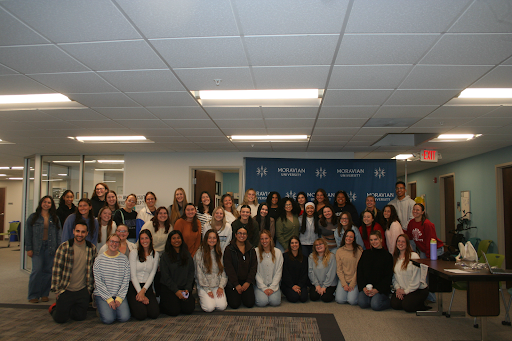
On Oct. 28, the Speech-Language Pathology (SLP) and Rehabilitative Sciences departments hosted a National Stuttering Day awareness event in the Sports Medicine and Rehabilitation Center (SMRC). This event, in collaboration with the National Student Speech Language Hearing Association (NSSLHA), focused on building allyship through stuttering awareness and how we can educate ourselves on communication disorders in general.
Disability advocate Patrick Festa hosted a discussion on how to be a consistent, supportive ally for those who stutter. As a person who stutters, he shared his journey and how stigmas had affected his life: “I’m here because for a lot of my life, I let my stutter control my journey. I let it take the wheel, and I dug a deep self-made hole of shame and anxiety and a lot of hopelessness.”
According to Festa, a stuttering ally is someone who respects autonomy, affirming stutterers by being patient with them. They also should hold people who stutter to the same life expectations as fluent speakers and not place them in stigmatizing categories, to “challenge society’s opinions of disability.”
He also emphasized the importance of listening and not interjecting when speaking with someone who stutters. To further prove this, he had the audience interact with one another, practicing both disengaged and engaged listening practices to demonstrate the impact of patience and paying attention.
“[Listening] is really the crux of it. It can’t be understated. We live in a world that doesn’t slow down, that operates on ‘what’s next?’ he said. “And I think that the art of listening to people goes against that, and not letting the pace of the world bog down patience.”
Festa also proposed promoting access to societal equality and equal opportunities. Those who stutter have careers as photographers, teachers, actors, and social workers. Festa himself works in a special education classroom, where he works personally with students with disabilities and fosters a supportive environment for them. He also worked at Camp SAY, a summer camp for young individuals with stutters. This two-week camp program provides young stutterers with a safe space to reach for their dreams and ambitions and offers speech therapy services.
Festa’s presentation exemplified the impact of allyship and autonomy in communication disorders and disabilities. As someone not in speech-language pathology, I found the session informative and gained insight from SLP students on what an awareness event like this meant to them.
“An event like this is so important to me because it helps give people firsthand education on necessary topics for growth within our community,” said Lindsay Rapp, a first-year SLP master’s student.
Mary-Jane Granito, ‘26, who described what an event like this meant as someone who is studying health science and communication disorders, agreed. “I really appreciated hearing his story and hearing how he talked about the highlights and how living with a stutter has helped him develop as a person, and also the challenges and barriers that he faced throughout his life,” she said. It’s one thing to learn about stuttering from a textbook or even a video, but it’s so enriching and eye-opening to actually hear somebody [talk about their] lived experience.”
She continued, “As an SLP, our role is to uplift that person, to guide that person, and to have a partnership with that person. As a clinician, we’re here to say ‘I am here to uplift you as a communicator so that you can feel confident and competent when you go into any space and you are speaking and that you know that you have a voice, and your voice is valuable and is worth being heard.’”