For most college students, finding a major can be a challenging journey. For Mia Espinal, a senior biology major who is graduating this May, that journey diverged from the one she started on when she first arrived on campus.
“I originally came to Moravian to study pre-med,” Espinal said.
She explained how biology seemed like “the obvious choice,” as it covers all of the requirements for medical school.
“But over time, I discovered that studying biology opened doors to so many other career paths. You could go to graduate school, earn a doctorate, or become a scientist; that really started to interest me.”
Espinal’s new focus led her to study ecological habitats and natural systems, a field where she felt she could contribute to a new understanding of responses to environmental change.
The Honors project that Espinal eventually pursued under the supervision of Associate Professor of Biology, Dr. Natasha Woods, analyzes the impact of storm frequency on shrub encroachment in unfamiliar areas. Last summer, Espinal traveled to the salt-tolerant grasslands of Hog Island, Virginia, to study encroachments that are affected by these conditions.
Hog Island is a barrier island and coastal landform, dominated by Spartina patens, a marsh grass that protects the mainland of Virginia from storm surges; the region also experiences dynamic environmental shifts. The encroachment of shrubs like Morella cerifera can produce a number of ecological consequences.
“Grasses hold on to sediment loosely, so they allow bigger islands to have plasticity when they erode and accrete,” Espinal explained. “So when they take the impact of storms, they absorb storm energy. But shrubs hold onto sediment more closely, so they allow islands to have more stability. And when they’re encroaching into these grassland areas, they’re becoming more stable and rigid where they don’t have to be.”
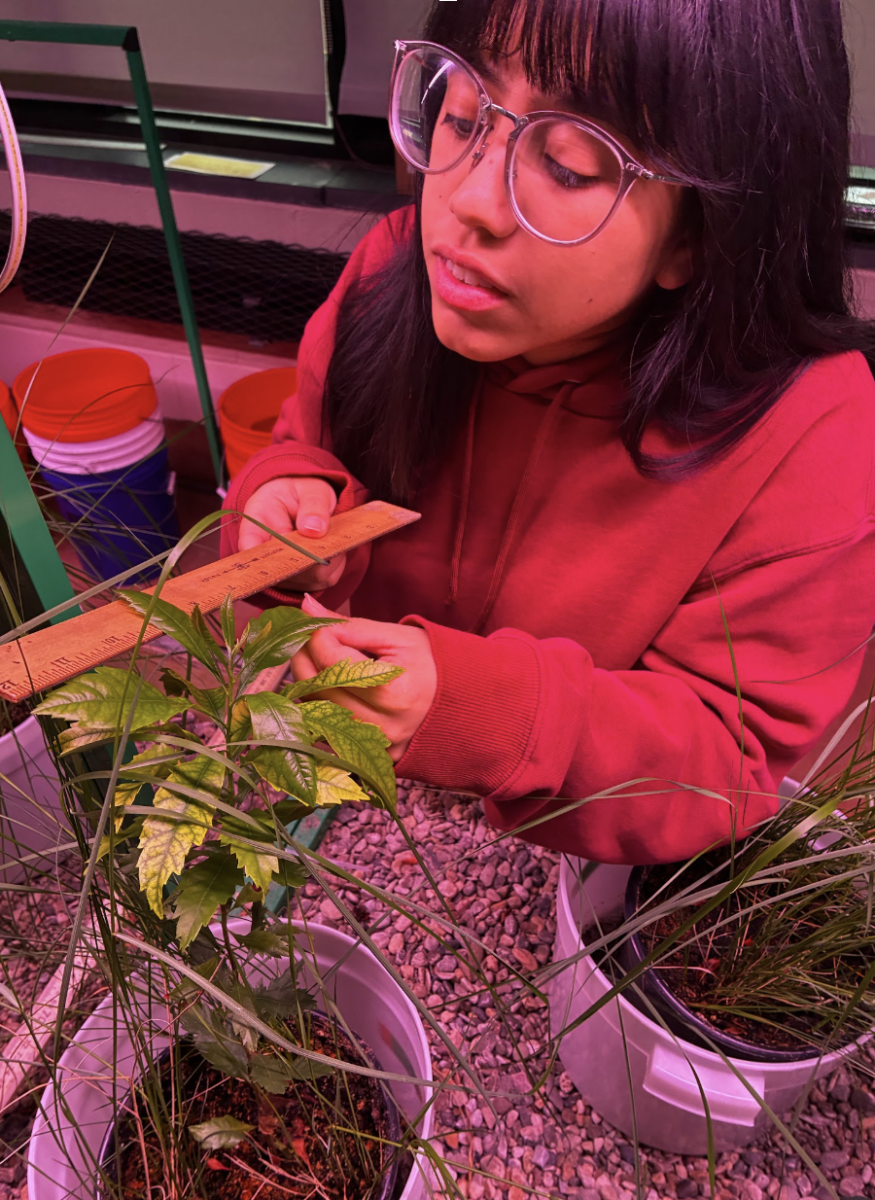
To investigate this phenomenon more closely, Espinal designed a controlled greenhouse experiment simulating Hog Island conditions. She recreated aspects of the environment with two species spreading across the island: Morella cerifera, the infectious shrub, and Spartina patens, the common grass species.
After planting one seedling of each species in 24 pots, Espinal later divided them into treatment groups based on a number of simulated storm surges they experienced in Virginia. These storms were simulated by watering plants with a saline solution of 30 parts per thousand, mimicking the concentration of ocean water. Afterward, Espinal allowed a three-week recovery period, until she flushed away the saltwater after 24 hours in order to replicate temporary flooding.
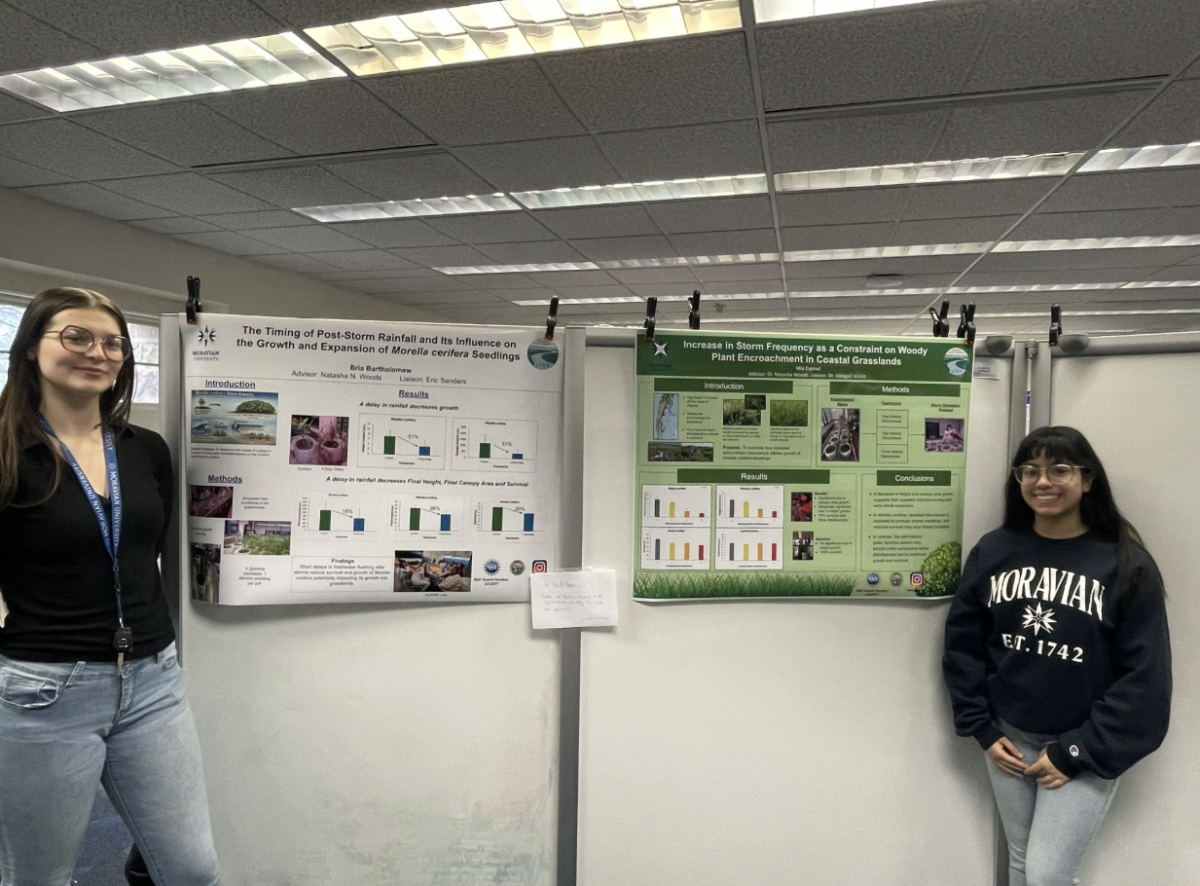
The results spoke for themselves. Morella cerifera growth decreased by 50% as storm frequency increased after two simulated storms compared to the control. In contrast, Spartina patens witnessed a 14% decline under the very same provisions. Espinal’s findings eventually revealed that frequent storm surges may hinder shrub encroachment while grasses continue to thrive, creating ecological balance across Hog Island.
Espinal credits Dr. Woods for sparking her interest in pursuing an Honors project and for constantly encouraging her. “She’s very patient and very helpful,” Espinal said. “She pushes me to do my best and always tells me I can do it.”
Outside the lab, the pair have shared meals and even attended conferences together.
“She’s not just a good advisor, but a great mentor,” Espinal said.
Espinal recently completed a research poster that allowed her to share summarized findings at a national scientific conference earlier this March. Displaying the results of her work turned out to be the most exhilarating part of the project. “There are going to be people from all around the country there — people in graduate school, people with doctorates,” she said. “I’ve been to conferences before, and I love it. After all this work, I can’t wait to tell people about it.”