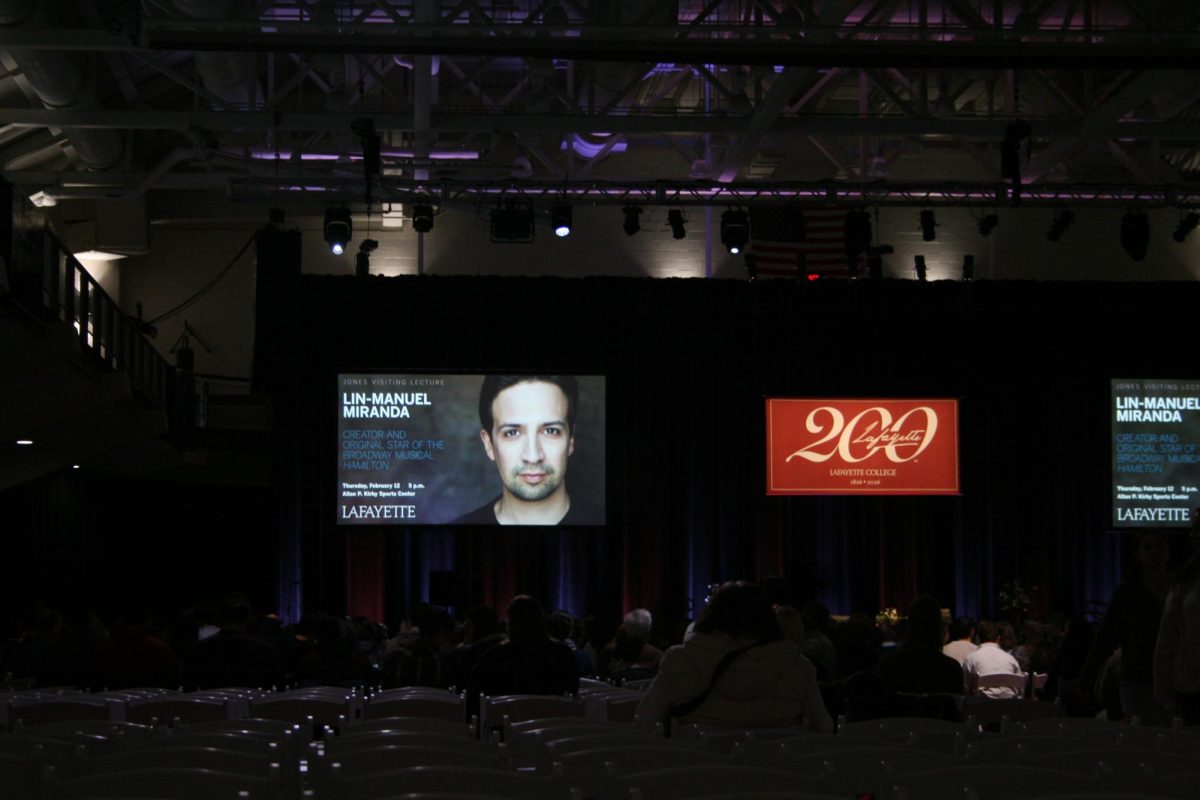
On Feb 12, Lin-Manuel Miranda, creator and lead in “Hamilton: An American Musical,” delivered the Thomas Roy and Lura Forrest Jones Visiting Lecture at Lafayette College in the Kirby Sports Center. President Nicole Hurd conducted the interview; the event was titled “Opportunity and Art: A Conversation with Lin-Manuel Miranda.”
From a young age, Miranda said he knew he was an artist, with his biggest inspirations being Steven Spielberg and “Weird Al” Yankovic. He discussed how attending a public school with funding and support for the arts was essential to his growth, especially through his involvement in the theatre program.
He recalled a story from his sixth-grade play, where the students performed 20-minute sections of various musicals and Miranda played Bernardo in “West Side Story,” Captain Hook in “Peter Pan,” and a son in “Fiddler on the Roof,” among others.
In that play, however, Miranda’s favorite role was Conrad Birdie in “Bye Bye Birdie,” where he played an Elvis-like character and all the girls swooned at his feet, despite Miranda being “three foot nothing.”
“The entire class had to swoon and faint at my scene, and all these girls I had crushed on had to pretend to fall with the sound of my voice,” he said. “I remember thinking, ‘Why would anyone do anything else for a living?’ And that was a high that I’m still chasing.”
As a Wesleyan University graduate, Miranda discussed the importance of his liberal arts degree. At college, he remarked that he “found his people,” many of whom still work with him, including two of his castmates from his freshman-year production of “Jesus Christ Superstar,” both now the vice presidents of his company, 5000 Broadway Productions.
At Wesleyan, he wrote his first draft of “In The Heights” as a sophomore, drawing immense inspiration from singers like Ricky Martin and Marc Anthony to write about his personal experience.
“‘In the Heights’ was my first time trying to bring all of my Latina, my family, and my culture to the things I was making,” Miranda said.
“It was in a very profound way, permission to bring all of myself into the room, and it’s my work, and it’s really when I started selling things like myself and not just an imitation of my heroes.”
Although Miranda stressed that following your heroes is an important phrase. When you start writing, “you should be chasing your heroes,” he said. “You should be saying, ‘I want to write something that sounds like this,’” even if you fall short of your heroes or your goals.
“And eventually, if you bring enough of yourself and your experiences, you will just start to sound like yourself.”
Miranda said he knew he wanted to write “In the Heights” because he wanted to write the roles that he would want to play, since he didn’t see them in the art form that he loved.
In 2002, when Thomas Kail, theatre director and television producer, and Miranda were working together on “In the Heights,” they worked odd jobs: Miranda as a professional substitute teacher, dancing at Bar Mitzvahs and backup singing for concerts. “In the Heights” opened on Broadway on March 9, 2008, at the Richard Rogers Theatre, and eventually won four Tony Awards, including Best Musical.
Later in the conversation, Miranda referenced his mentor Stephen Sondheim, composer and lyricist, and emphasized that no masterpiece arrives fully formed.
“Rewriting is writing,” Miranda said, recalling how Sondheim once described cutting lyrics from “West Side Story” after months of work; that showed Miranda that great writing is not divine inspiration, but rather, a process of revision and collaboration.
Hurd asked Miranda if, upon first reading Ron Chernow’s biography of “Alexander Hamilton,” he had any idea what the musical would culminate in; his response: “Instantly.”
Miranda said he had known since high school that Hamilton had lived an interesting life because he had written a paper on the Hamilton-Burr duel.
“I got a B minus. I don’t want to talk about it,” he joked.
He picked up Chernow’s book at an airport while on vacation from “In the Heights” in 2008, knowing the book would have an interesting ending. Regarding the namesake of Lafayette, Miranda said he knew he needed to find the “coolest” person he knew to play the role: Daveed Diggs, a longtime friend of Hurd.
“Lafayette comes here [to the U.S.], and he goes, ‘Is there a revolution? I want to fight in it!’ And he has this wanderlust for battle and for justice,” Miranda said. One of the last lines in the play that Miranda added was a line for Lafayette: “You gotta put some thought into the letter, but the sooner, the better / to get your right-hand man back.”
Regarding his inspiration, Miranda always resorts to love.
“Hate can get you, maybe even a great song. Rage is a fuel source; I think it burns hotter, and I also think it blows up the ship that it’s trying to fuel. I have never been able to sustain it,” he said.
“Writing is hard enough, because it’s just fucking lonely. I don’t know how to do that and be upset all the time.”
One of Miranda’s defining moments in his career was seeing the play “tick, tick…BOOM!” in 2001, following the 9/11 attacks – a play that Jonathan Larson wrote before his sudden death in 1996.
“Now here’s the show that basically says, hey, writing musicals is really hard. Would you still write musicals if you never saw success in your lifetime? If no one ever saw your shows while you were alive? Sit with that, motherfucker,” Miranda said.
He describes how the entire musical felt like a 90-minute personal attack, facing the consequences of spending your life creating something when the chance of recognition and success is inordinately small.
Miranda decided he was okay with that.
The conversation concluded with a glimpse of his current project, an adaptation of “The Warriors” that he is developing with playwright Eisa Davis. Miranda described the project as a long-gestating idea that resurfaced after the success of “Hamilton,” evolving into a concept album featuring collaborators across genres.