Moravian University announced its revised mission statement on Dec. 3, removing the term “liberal arts.” Administrators say it aligns with the changing identity, but has also sparked a conversation about the future of the humanities on campus.
The updated statement now reads: “Moravian University’s education prepares each individual for reflective lives, fulfilling careers, and transformative leadership in a world of change.” Previously, the statement defined the institution as offering a “liberal arts education.”
The change came through the university’s Middle States Commission of Higher Education accreditation self-study, in which faculty and staff examined whether the university’s mission accurately reflected its current student body and academic offerings.
Middle States is a global institutional accreditor recognized by the U.S. Secretary of Education that reviews colleges and universities primarily in the mid-Atlantic region.
The self-study is a formal evaluation to show that the university meets the seven standards of Middle States. Committees of students, staff, and faculty form and are each assigned one standard to review.
The committees collect data and documents, review programs and policies, and then compare this evidence to the Middle States standard they are assigned. They then write a report explaining why the university does or does not meet the standard, and make recommendations for improvement.
“The committee recommended that we’re much more than a liberal arts college,” Grigsby said. “We didn’t remove liberal arts from Moravian; we removed a phrase that no longer accurately describes who we educate and how broadly we educate.”
Standard One of the Middle States self-study review requires institutions to reassess their mission statements. Middle States-accredited institutions complete a full accreditation review (self-study) every eight years.
Grigsby shared that nearly 40% of Moravian students are now enrolled in graduate and professional programs that do not follow a traditional liberal arts structure.
“As we’ve grown into a comprehensive university, that modifier [liberal arts] no longer represents the full range of our students,” Grigsby wrote in an email to the campus community.
Ultimately, the Board of Trustees unanimously approved the revised language. The word “education” was intentionally retained in the statement after faculty feedback, stressing the importance of the university’s history of educating all.
Cathy Coyne, associate professor of practice in public health and a Faculty Senate member (Moravian’s faculty governing body), said liberal arts principles are still present across professional and health science programs.
“Undergraduate professional and post-professional programs will develop critical thinkers, which is also a keystone of liberal arts, who are integrated in interdisciplinary practice,” Coyne said. “Even though it’s not in the university mission statement, it’s very much grounded in how we educate students.”
However, some students have voiced concerns for liberal arts programs on campus.
“I couldn’t care less about whether or not ‘liberal arts’ is included in the mission statement,” Owen Levan-Uhler ‘26 said. “But I recognize that this is an indication of the University’s trajectory: further dismantling of Social Science and Humanities programs.”
Levan-Uhler, an English major with an education minor, went on to explain that as a humanities major, he has found fewer and fewer course offerings and struggled each semester to register for classes.
“Humanities students are few and far between,” Serena Elsasser ‘27, a studio art major, said. “This year, there were no incoming freshmen declared as a studio art major (which you can declare as a freshman).”
Coyne noted that faculty discussions raised concerns that removing the term “liberal arts” would reduce emphasis on humanities disciplines and majors on campus. However, she said many professors believed liberal arts approaches remain integrated through the MILE general education curriculum and interdisciplinary coursework.
University data suggest that participation in humanities programs has not declined, despite institutional expansion into professional programs.
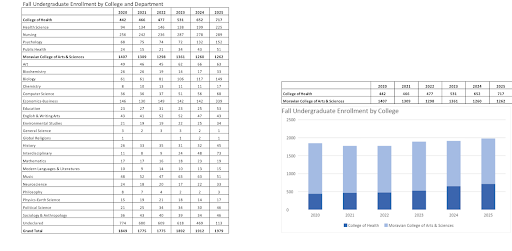
According to data provided by Sharon Maus, director of Data Analytics, enrollment within the Moravian College of Arts and Sciences has remained relatively stable over the past six years. Course enrollment data also shows consistent student participation in arts and sciences classes.
Grigsby described the revised mission statement as aligning the institution’s language with the realities of the institution’s academic offerings.
“The mission statement is catching up to our branding,” he said.
He also described the change as a return to Moravian’s early education philosophy, predating the American 19th-century liberal arts college model.
“Moravian was educating people before American liberal arts colleges even existed,” he said. “Removing those words didn’t remove liberal learning. It removed a barrier so every student can see themselves in the mission.”