When pursuing Honors at Moravian, the university’s best and brightest students make posters that distill the projects they’ve been researching all year. On March 19, 2026, in Reeves Library, they presented their posters to the Moravian community and answered questions about them.
Chemistry major Edward Nuber ’26 conducted cancer research by studying telomeres. These protective caps at the end of DNA strands are used to determine a person’s molecular age. Telomeres can also have their aging process disrupted by cancer, shortening the lifespan of people with cancer. Through his studies, Nuber i’s determined that a combination of anti-cancer drugs and nucleic acids could change the structure of a telomere.
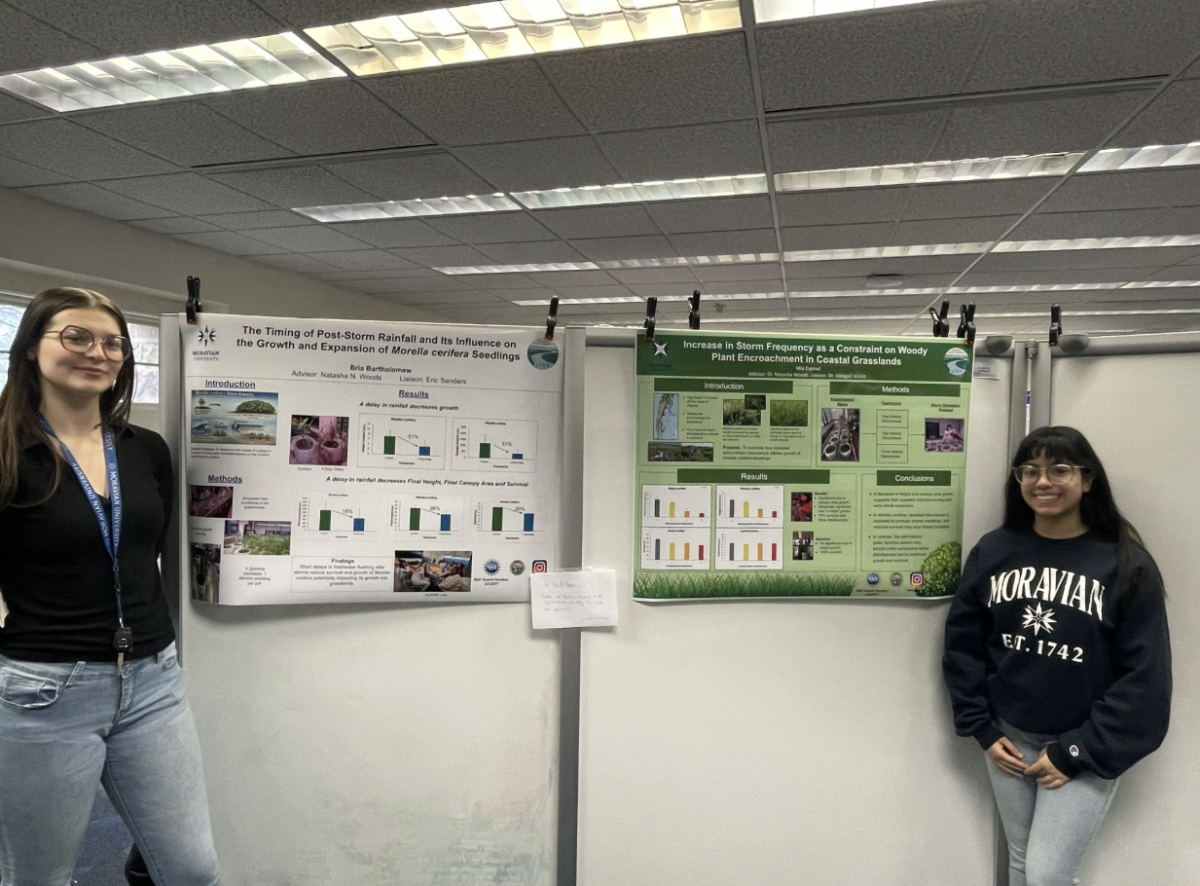
Both Bria Bartholomew and Mia Espinal investigated how saltwater affects plant growth and encroachment in ecosystems.
Environmental studies and biology major Bartholomew ‘26 studied how salt water changes the root growth of Morella cerifera seedlings. She was inspired by Associate Professor of Biology, Dr. Natasha Woods from Moravian’s biology Department, inspired Bartholomew with her who conducted research on the barrier islands of North Carolina.
Bartholomew determined that a delay in rainfall decreases the height and canopy coverage of Morella certifera in these regions, by simulating various conditions in the labs of Collier Hall.
Biology major Espinal ‘267 researched how increasing storms affect woody plant encroachment on Hog Island in North Carolina. She explained that two different types of plants (Morella cerifera and Spartina patens) were flushed with a varying amount of salt water in the lab to simulate rainfall and then measured both plants for altered or impacted growth.
Through this experiment, Espinal determined that Spartina did not suffer any substantial height difference and had a 100% survival rate; however, Morella had a loss in height and canopy coverage, as well as a 70% survival rate.
Nursing major Meghan Myers, ‘a class of 2026 nursing major, researched student awareness of the relationship between iron deficiency and maternal- fetal impact. Myers explained that she was drawn to this area of study after a friend’s family member was iron-deficient and died in childbirth.
Earlier in her research, Myers surveyed Moravian students on their knowledge of iron deficiency, then compiled bar and pie charts to visualize the student responses. She stated that her goal was “finding the gap between what people thought they knew and what they actually knew.” From there, Myers determined that many students knew less than they thought relating to iron deficiency, and even fewer were aware of the potential dangers it held for maternal and fetal health.
English and political science major Liz Kameen ‘26 researched the “mad woman” archetype in literature. Kameen explained that the most common figure attached to this concept is “Jane Eyre”’s Bertha, Mr. Rochester’s wife, who is kept locked in the attic throughout Charlotte Brontë’s novel.
She also read “Wide Sargasso Sea,” a prequel to “Jane Eyre,” followed by several other classic and contemporary works, including “The Bluest Eye,” “My Year of Rest and Relaxation,” and “The Yellow Wallpaper,” to better understand this literary phenomenon. Kameen said that her interest was first piqued when she took Assistant Professor of Practice in the Department of English and Writing Arts Dr. Andrew Crooke’s Intro to English Studies course, for which she read Kate Chopin’s “The Awakening.”
From there, she began to dig into the reasons why the “mad woman” was so common. Kameen argues that this trope evolved and continues to exist largely due to sexism and racism surrounding women who do not fit into “traditional” feminine roles.
Similarly, English and history major Fatimah Bouri’s ‘26 project focused on the Third World Woman’s Alliance (TWWA), an intersectional feminist group from the 1970s that focused its activism primarily on women of color. Bouri ‘26 explained that she wanted to research feminist organizations from this era because it is “such an important time.”
TWWA served as a platform to voice concerns relating to reproductive justice and medical racism, as many of the women within the group were new mothers or belonged to a community with a high infant mortality rate, such as Puerto Rican and Black women. Bouri said that these women “fought for power back into the community” and even advocated for incarcerated women. Bouri visited Smith College earlier in the year to access physical meeting notes and committee memos for her research.
Elizabeth Hutchinson ‘26, a music and speech therapy major, combined her written research with a performance aspect of her honors project. Hutchinson investigated the lives and compositions of three women who were interned at the Auschwitz concentration camp during World War II.
Using only instruments that would have been available to the women’s orchestra at Auschwitz, she sought to represent each of the women through the scores she composed. In addition to her paper, an all-women’s concert performance, which Hutchinson both conducted and performed in, took place on April 19 in Foy Hall.
While students have worked hard to create their posters, some designed by Studio South, Moravian’s student-run in-house graphic design studio, this was not the culmination of their research. Honors theses were due April 13, and during the weeks of April 20 and 27, the honors students defended their theses to a committee of professors, including an outside reviewer.
Following the oral defense, projects are either approved or denied honors status; successful theses are then printed, bound and added to the Reeves Library collection. The presentation in Reeves Library is one aspect of a much larger and rigorous process and represents the highest level of academic achievement a Moravian student can attain while still an undergraduate.