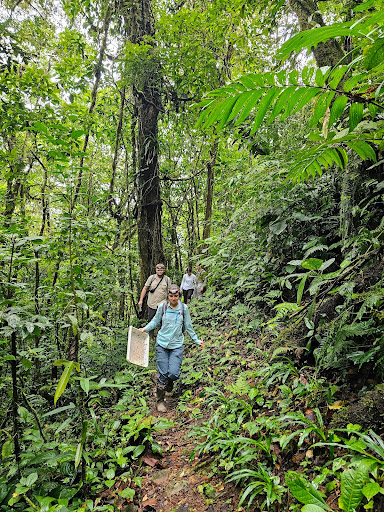

Over the summer, Dr. Daniel Proud, associate professor of biology at Moravian University, led two different expeditions in Central America to continue his extensive research on Opiliones, a type of arachnid that exhibits great diversity in this region. The first trip took place from May 5 to 15 in Costa Rica, and the other from July 6 to 23 in Panama.
With the help of Moravian undergraduates and other colleagues, Proud collected about a thousand individuals to study, which he brought back to the United States to sort and identify.
Opiliones are an order of arachnids, commonly recognized as “daddy long-legs” in the USA. They are found all throughout Central and South America as well as in the Caribbean.
These small creatures are harmless to humans and are “opportunists” in their diet, as they will eat almost anything edible and smaller than themselves, such as pests, fruit, and flower bits. The tropical species are estimated to have lifespans of three to five years, although there is not enough research to confirm this.
Their dimunitive, pebble-like bodies contrast with their long, hair-like legs. This order of arachnids often gets mistaken for spiders for their spider-like appearance, but is distinguished by many unique characteristics. Unlike spiders, Opiliones do not produce silk, so they are not capable of making webs. They do not carry venom harmful to humans, and have crab-like claws instead of fangs.
Proud makes sure to distinguish the difference in his teaching, as his research goes towards finding and identifying undescribed Opiliones species. The mission, which nvolves weeks of field work followed by months of work in the lab, is demanding.
Specimens were collected through field work, usually during night hikes. After individuals are recorded and collected, the researchers prepare for hours of tedious lab work. Individual details are then studied, and DNA is extracted in order to make a subset of the genome to be sent for data sequencing using bioinformatic tools, which will give biologists more information to label individuals.
Over 100 samples have already been prepared since the group came back from their summer expeditions; it is anticipated that hundreds of species are yet to be found within the collection. These identifications will complete studies of biologists before Proud, while making way for future biologists to build off of his work.
Proud’s up-close pictures of some individuals show specimens that are varied in pattern, color, and size. He reminisced about both trips, noting the intensity of the field work in Panama, sharing that 14 out of 17 nights of the trip included night hikes to collect data. This was a stark contrast to his experience in Costa Rica, where the group only hiked for four out of the ten nights to ensure they were getting other experiences in the country.
Anderson DeChario, ‘27, who attended the Panama expedition through a SOAR project with Proud, described the experience as “full of adventure.” DeChairo stated that he now has a “greater appreciation” for both the field of work and for the amenities — such as hot water and electricity — which students don’t truly appreciate until they are staying in remote locations.