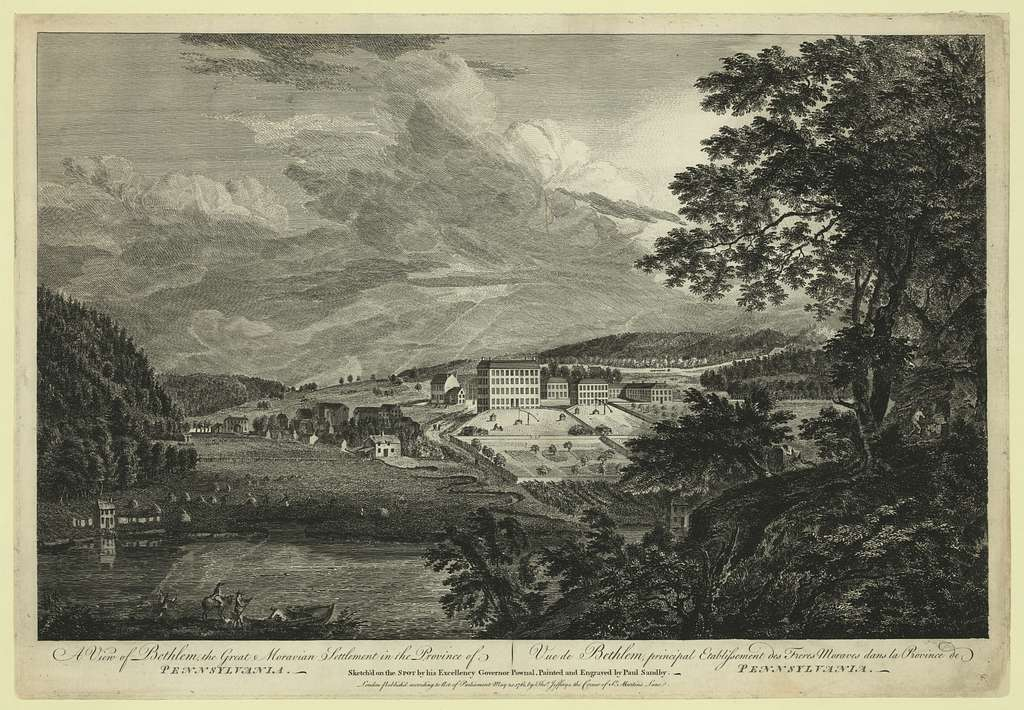
Reeves Library recently unveiled a new display on the main floor highlighting the Black and Indigenous people living in and around early Bethlehem. It serves as a reminder to the community of the complex history of our university’s namesake.
As many students and faculty may report, the university’s narrative of the Moravian settlements in Bethlehem emphasizes religious persecution in Europe, migration to the Americas, and Moravians’ desire to freely practice their beliefs. And thus, in 1741, Bethlehem was born; it was a utopian, closed community for those willing to fully accept the Moravian faith.
Black and Indigenous people only become a part of the narrative at precise points. The university emphasizes that the early Moravians welcomed and educated the Native and Black converts in the Moravian community. Yet, it often fails to recognize the realities of race relations in colonial Bethlehem.
Bethlehem was not only a religious haven; it also served as a base for conversion missions among local Indigenous peoples, mainly the Lenape (Delawares). They learned the tribes’ languages to aid in conversion practices, which many other religious sects looked down upon.
While we can acknowledge that the Moravians did it differently from most others during that time, we must condemn all forms of slavery and settler colonialism.
Not only did individual Moravians enslave people, but the Moravian Church did too, listing them as property in their registries.
Additionally, Native converts were given new ‘Christian’ names and could only enjoy the full benefits of the Bethlehem community if they completely accepted the religion.
No matter how “good” the Moravians were to the enslaved people and Natives in Bethlehem, it will never erase the fact that they purchased and enslaved people or that they were colonizers of this land. No matter how “great” the Moravian narrative makes early Bethlehem seem, their success will always be tainted by the legacy of forced labor and stolen land.
Bethlehem and Moravian University sit on land that was fraudulently taken from the Lenape by William Penn’s heirs, an event that is known as the Walking Purchase of 1737. Many community members do not know this, as it is not included in the university’s land acknowledgement.
Further, the early Moravians were meticulous record-keepers and wrote down daily happenings in the Bethlehem Diaries and required that members leave behind memoirs documenting their lives. The display highlights two memoirs, those of Magdelena Beulah Brocken and Andrew the Moor.
Magdalena was born on the Guinea Coast of Africa and was sold into slavery during her childhood. Her master sent her to Bethlehem in 1743 to “save her soul.”
Andrew was born in Igbo land (near modern-day southeastern Nigeria). He was sold as a child into slavery and was later bought by a friend of the Moravians, who brought him to Bethlehem in 1746.
Magdalena and Andrew married in 1762 after Magdalena was freed. Andrew remained enslaved until his death. They are buried in God’s Acre, the cemetery behind Central Moravian Church.
Reeves Library invites students, faculty, and staff to visit the display on the main floor of the library and to participate in a casual roundtable discussion about the role of the Moravians in the institutions of colonization and slavery on Dec. 2 at 12 pm.