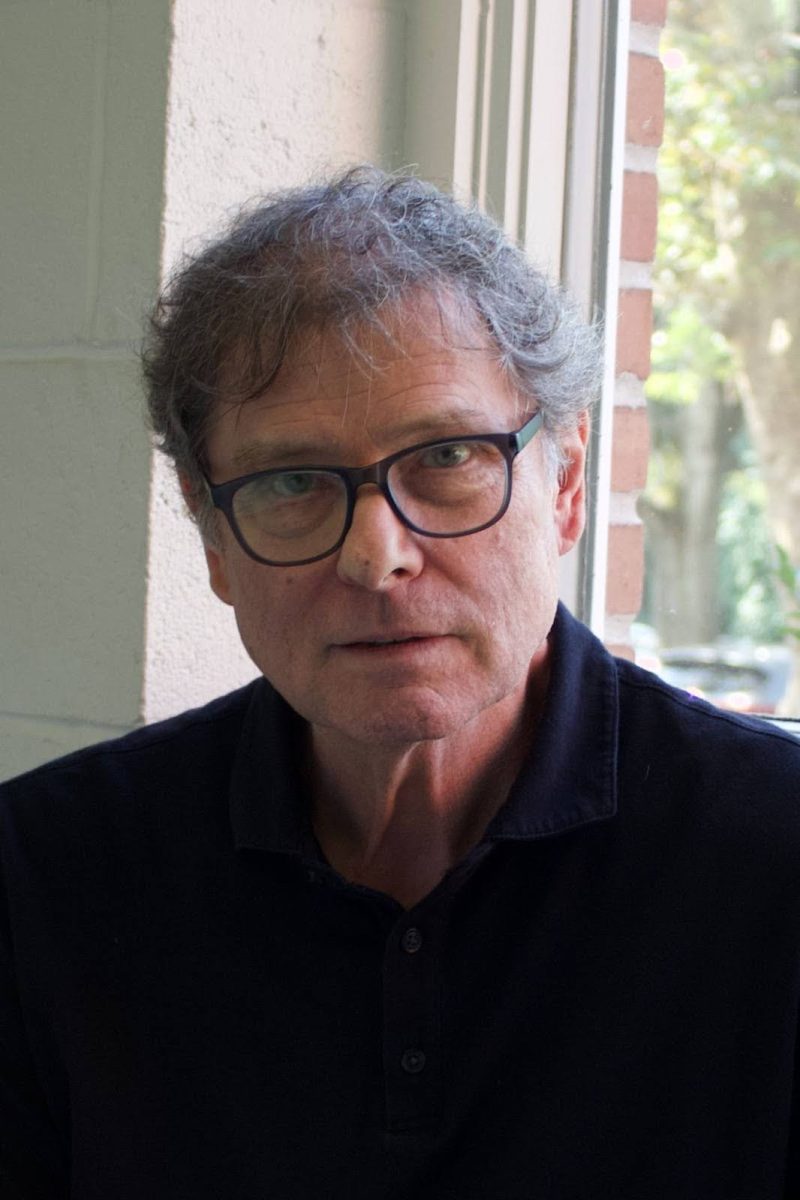

Madeleine Farris is an associate professor of mathematics at Moravian University. They obtained their bachelor’s in mathematics and classics from Wellesley College in Massachusetts and master’s and doctorate in mathematics from the University of Illinois. They joined the math department in 2025.
What inspired you to go into your field of study?
I’m not sure I would have pursued a career in math if not for my high school math teachers. They ensured that our math classes were creative, fun, and collaborative, and encouraged me to pursue a career in math. Before high school, I didn’t really consider myself a “math person” because I struggled with memorizing formulas and thought that being creative meant I couldn’t excel in STEM fields.
What research are you currently working on?
My research is in the field of math called “logic.” I like to describe logic as “meta-math” because it investigates how we know the math we do actually works. My research within logic specifically investigates mathematical objects that have some kind of geometric structure. I focus on categorizing those objects based on how complex (or, on the other hand, how tame or simple) they are.
What job would you have if you couldn’t be a professor, regardless of salary and job outcome? Why?
When I was a kid, I was sure that I would be a writer when I grew up. I loved reading books; I probably read two or three books a week. I loved how immersive stories could be and how they could help us see things from new perspectives. So, I think in another timeline, I’d be an author.
What do you know now that you wished you knew when you were in college?
Something I wish I had learned earlier is the value of collaborating with other students in my classes. When you work with other students, they can help you when you don’t understand something, but also when you help them with something, you gain a deeper understanding of the material. Math is such a collaborative field, and our math classes should be, too. Plus, it just makes working on homework and studying way more fun!
What is your biggest student pet peeve?
My biggest pet peeve is when a student speaks or thinks badly about themselves because they don’t get something right away or make a mistake. When we write an essay, it’s usually assumed that the essay will go through multiple drafts. So our first attempt won’t be perfect, and the final draft might look very different from the first. Math is the same: our first attempt might not be ideal, but we can keep revising that attempt until we understand the concept better.
What should students expect from your classes? What is the secret to succeeding in your classes?
I hope every student leaves my class feeling more confident in their mathematical ability and that they have more tools at their disposal to solve complex problems. I think a lot of students would say they’re just not a “math person.” I hope I can bust that myth for them by helping them see how many math skills they already have, and helping them gain even more. I’m not sure there’s just one secret to success, but here’s one important tip: regular practice is essential to success in a math class.
What was the last streaming show that you binge-watched, or the last good book that you read?
The most recent season of “Game Changer” on Dropout is my favorite show that I watched recently. And the last good book I read is the “Murderbot Diaries” series (it’s so good that this recent read was actually a re-read).
What is something interesting about you that most people don’t know?
In college, I double-majored in both math and classics. I didn’t really plan for the classics part, but I ended up taking a bunch of classes in the department, and enjoyed them enough to stay. As a nice bonus, I got to take a trip with the department to Greece to visit a bunch of archaeological sites we studied in our classes.
Do you believe a hot dog is a sandwich?
I admit, I’m somewhat of a sandwich radical. You’d be hard-pressed to find something I wouldn’t qualify as a sandwich. Someone once convinced me that an eclipse is a sandwich (think about it). But I’m also pretty sure that the sandwich is in the eye of the beholder. To me, a hot dog is a sandwich; to you, it might not be. That’s okay, we can still be friends.